
Encountering the Metaphor
On how to say what we mean without saying it at all and other ways of finding your way home.

It was a year without milkweed, without rhododendron blooms, without rain, without time. Outside our bedroom window, newborn starlings fell from their nests. When I found them, I buried them by the spring house, dreaming of one day digging up their tiny bones. Through one blurred eye, I caught sight of blood dripping from the wing of a hostile fledgling. I watched as its beak plunged suddenly into the belly of a cat.
I measured my breath against yours.
One afternoon, I watched you from the window come upon one of these babes, grotesque and sprawling on the pavement below the patio. Without warning or hesitation, you took the sole of your boot and kicked it into the bushes nearby.
This was all before I reached for my phone and clocked back in.
Later that day, over dinner, I tell you (more than once, but with no less enthusiasm) that I feel as if I am becoming un-tethered, drifting further away from It All each day. The feeling grows as I type, as I scroll, as I calculate myself against you, and her, and them.
To be alive, to live a day, is a sacred thing: to wake up and make breakfast, to draw circles in the dirt under the table with your foot, to press your palm against the cheek of someone you love, to hear the music swell behind a closed door…
In the beginning, there was nothing, and then there was the Word. Language brought forth consciousness, and through language, one learned that one "lacks," and thus desire was born. Light illuminates this desire and all of it’s shadowy entanglements. But nothing can truly ever be obtained, and that which cannot be held can only be reflected like a mirror (a symbol) or refracted like a prism (a metaphor).
In these moments, so precious and imperiled, I have become dreadfully aware of what has been lost. Where there was once meaning and complexity and painful, delicious yearning, there is now a homogeneous zone of emotional warfare, commodified for consumption, predigested slop, a distant hum growing closer and closer still…
Beauty is a metaphor, not inherent in objects but intrinsic in living, breathing beings. What has been lost? It’s as if the light has been extinguished in our collective consciousness, or at least dimmed to a devastating, pernicious state of decay. It’s the feeling of slipping away, un-tethered, beyond alienation, drifting listlessly towards atomization, considering seriously, the melting calm of annihilation.
I’m troubled deeply by this sensation -not because I fear this inevitable annihilation, but because I recognize it as a mask of something much more sinister. While I may perceive the sensation that I am drifting away, alone and doomed, in actuality I’m much more tethered than ever before. The string that ties me to you is not flanked by a song of exaltation and rapture, but is a string that binds us in the shrieking cries of collective paranoia. This paranoia forces us to categorize one another, find differences and tyrannize, and initiate mechanisms of control that drown us from within.
In the beginning, there was the Word, and the Word brought forth the Light.
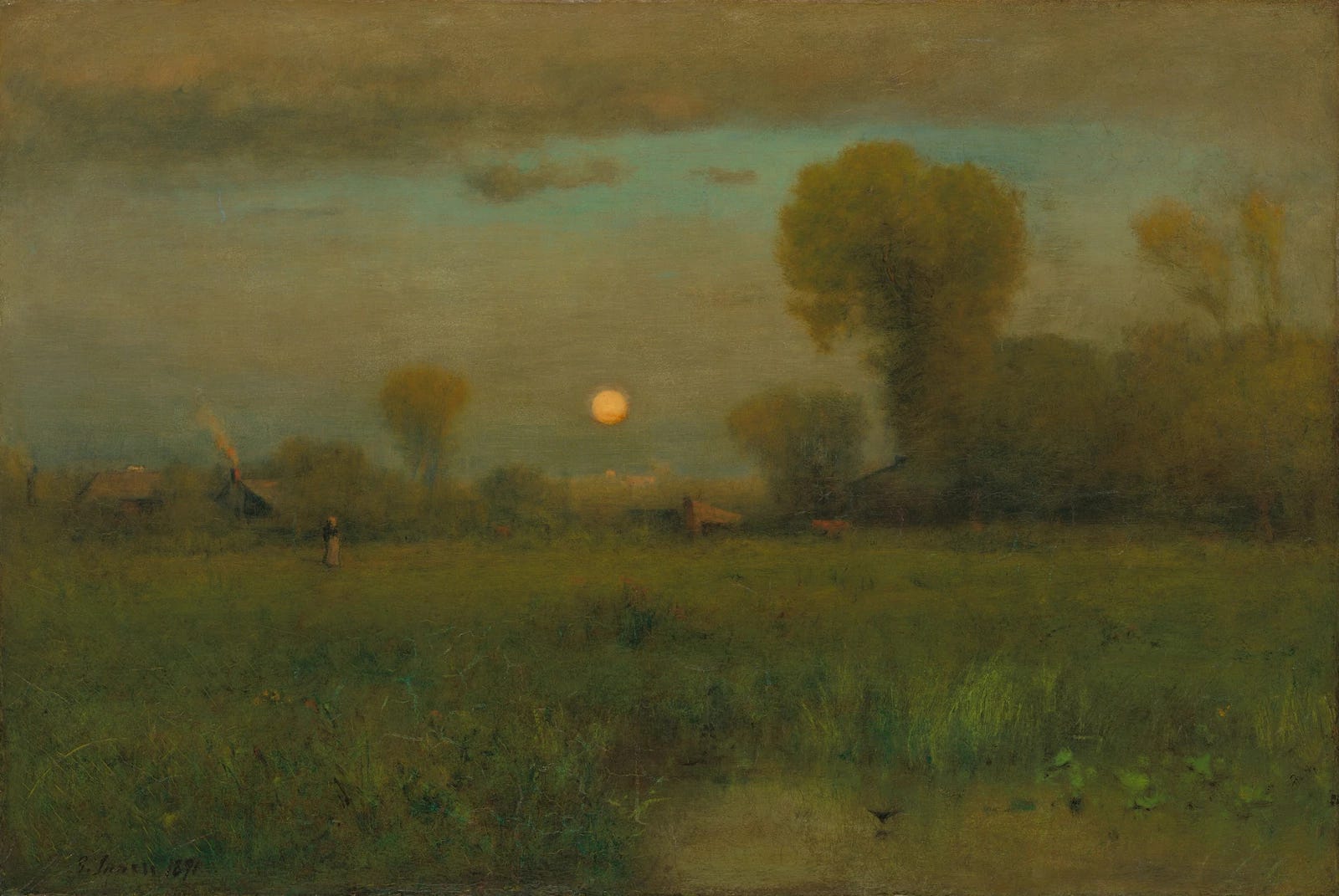
For months, I have been staring at this painting through the myopic, vertical screen of my phone, trying to find the words to talk about it. It’s a painting that is not necessarily remarkable, in any sense of the word, but does encapsulate this critical juncture where metaphor is evoked, meaning is summoned, and a moment is captured that is singular, whole, and unwaveringly true.
The painting is George Inness’ “Harvest Moon” (1891), a painting that elicits an ideal that is nearly unknowable and unattainable in post-modernity. It portrays an atmosphere of contentment and harmony with nature that most of us can only nostalgically long for. The memeification of this nostalgia can be felt (with unflinching despair) by the popular Internet phrase, “Go touch grass.” One can look at the subject of this painting and suspect that behind her lies a day of honest work, ahead lies a night of rest, and only in this very moment are we allowed an intimate glimpse into the present: a coalescence of spirit and body — and not just the body of a flesh and blood human — but a unity between the land and that which lives on and within it.
The Hudson River School was the first truly American art movement. Painters like Thomas Cole, Frederic Edwin Church, Asher Brown Durand, and later George Inness were heavily influenced by the Romantic period, which originated in Europe toward the end of the 18th century. The Romantic movement celebrated nature in a way that went beyond aesthetics, glorifying it to the point of evoking spiritual arousal. It sought to capture “kairotic” moments of the Beautiful, the Sublime, and the Opportunity. Artists of that era gazed out at their newly expanded world with curiosity toward the monumental dangers and unknown fates that lay before them. This blind faith in human potential, made in the likeness of some Creator, led to some of the greatest representations of human complexity in art, music, literature, and beyond.
There are no great books or works of art today that can guide us or offer a moral framework to shape our lives. Even if there was a Tolstoy or a Tolkien alive today, they would likely be canceled and crucified before their work could be turned into a bingable Netflix series with a diversified cast. What we have in place of great art is a virtual identity machine - one that runs off of emotional hysteria. The machine that we are tethered to doesn’t feed on Sublimity, but rather fear and guilt. It propagates fear by forcing us to measure ourselves against everyone else to ultimately create one, collective, smooth-brained, submissive body with only one objective - to consume itself into oblivion. This mechanism of sterilization and submission offers the promise of Unity, at last! Equality! But to get there, we must first prove to the machine that we can repent for our sins as flesh and blood humans with a propensity for the pursuit of self-actualization. To do this, we feed it our poetry, our artistically-framed photos, our hopes, dreams, fears, desires, and ultimately, our faith in our own voice and our connection to others.
In the beginning, there was the Word, and then there was the Light, and the Light shined on all of the Beauty and all of the Lack, casting an unknowable penumbra behind the Truth.
The year without is finally coming to an end, at last. Beyond the decay and the drought, there is the other side: a flood, a war, a flock to tend to, an ocean, immense and inexhaustible. Despite what has been lost, there is still Beauty, Love, Fear, the Sublime. As long as there is light and there is language, it’s still ours for the taking.
👏👏👏💙